Questions, models, and physical intuition documented clearly enough to stay useful after the result looks finished.
This page treats physics work like a real notebook page. The model, the assumptions, the correction, and the meaningful plot belong in the same place.
- Question
- The physical idea or behavior I am actually trying to understand.
- Model
- The assumptions, equations, and simplifications used to test it.
- Evidence
- The graph or state-space view that changed my understanding of the system.
A model gets interesting once it stops flattering the theory and starts exposing the weak assumption.
Projects that are useful because they preserve the reasoning around the physics, not only the finished visualization.

Orbital transfer mapper
A project that became more revealing once the page stopped hiding the uncomfortable parts of the math and let the trajectory logic stay visible.

Particle field study
A simple-rule system that becomes physically interesting once the edge cases are treated as data rather than noise.
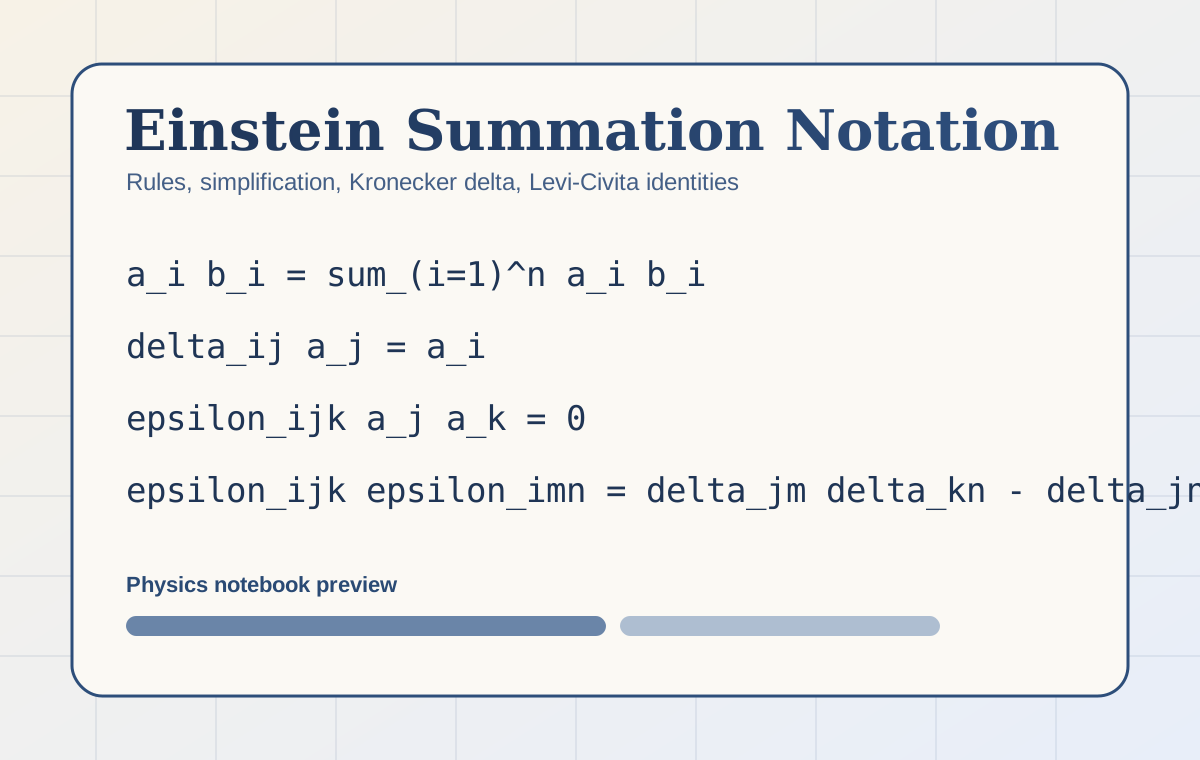
Einstein summation notation primer
Neatly structured notes covering rules, conventions, simplification, Kronecker delta, Levi-Civita symbol, and high-use tensor identities.

Numerical methods notebook
A dedicated record for integration, interpolation, checks, and the small reusable pieces that keep showing up in physical models.
The point of this page is not to look technical. It is to make the technical reasoning easier to revisit.
- Start with a physical question. If the page cannot name the phenomenon clearly, the rest turns into decoration.
- Keep the first honest failure. That is usually the point where the model starts teaching something real.
- Save the revealing plot. One good graph usually explains more than several polished screenshots.
- Project type
- Orbit study, dynamics experiment, numerical notebook, or visualization pass.
- Useful artifacts
- Plots, equations, parameter tables, phase views, and a note on where the model struggled.
- Next move
- The next physical question to test, not just a general plan to improve it later.
-
14 Mar 2026
The boundary conditions finally made the model stop flattering itself.
The interesting version began where the clean output started breaking under more honest assumptions.
-
08 Mar 2026
Pulled reusable checks into a cleaner notebook structure.
The methods shelf matters because it shortens the distance between future ideas and implementation.
-
03 Mar 2026
Saved the plot that explained the system faster than the write-up did.
That is usually the visual worth carrying into the permanent archive entry.
Coming back months later and still remembering what the system was supposed to teach.
If I can reopen a page and immediately see the question, the model, and the next useful test, then the Physics room is doing its job.